
Download the free template – just fill it in
Free to use. Fill in the fields, sign and email it to your freight forwarder – done.
What is a proforma invoice?
A proforma invoice is a customs document – not a bill. Nobody pays it. It shows who is sending the goods, who is receiving them, what they are and what they're worth, so the export declaration in Sweden and the import clearance in Norway can be done correctly.
It is always the sender who writes the proforma invoice – not the shop where the item was once bought, and not the carrier. There are no rules about how it should look; what matters is that all the details are there.
Proforma or commercial invoice – which one do you need?
The basic rule: if the receiver is paying for the goods, the commercial invoice (the real invoice with price and payment terms) is customs' first-choice document. If the goods ship without payment – gifts, samples, warranty replacements, returns, repairs or goods to your own office – use a proforma invoice.
In practice it's simpler than that when you ship with us: for most shipments, a proforma with real details is enough as the customs basis, and we'll tell you if your particular shipment needs a commercial invoice instead. The one thing that's never negotiable is the value – it must be the goods' real value (the price actually paid), and if a later final invoice shows a different amount, the declaration must be corrected afterwards.
The content is essentially the same in both documents. The difference is that the proforma is titled "Proforma Invoice" and makes clear that nothing is to be paid via that particular document. The checklist below therefore works for both.
What the proforma invoice must contain – line by line
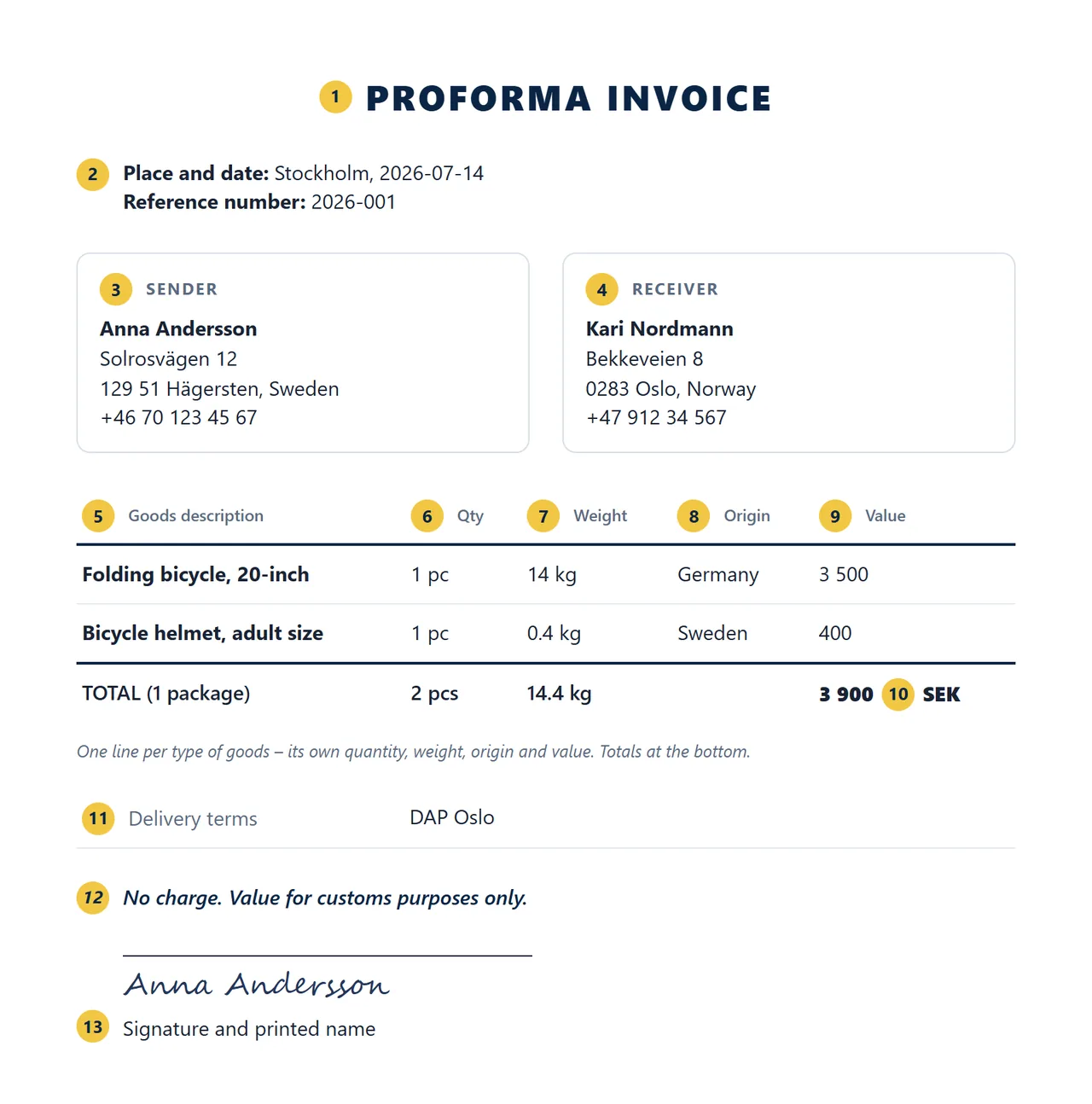
The customs authorities on both sides of the border want to see these 13 details. The numbers reappear in the example below the list:
Shipping several different items? Use one line per type of goods – with its own quantity, weight, country of origin and value – and a totals line at the bottom. Multiple units of the same item go on one line with the quantity stated.
- 1. The heading "Proforma Invoice" – so the document isn't mistaken for a bill
- 2. Place, date and your own reference number (e.g. 2026-001) – the reference is used in the export declaration
- 3. Sender: name, address and phone number
- 4. Receiver: name, address and phone number – double-check this; clearing goods on the wrong party is the most common error at Norwegian import
- 5. Goods description: detailed, per item type. Write "folding bicycle, 20-inch" – not "sports equipment". If you're sending a gift or a sample, say so here (e.g. "Gift – bicycle helmet")
- 6. Quantity with unit (e.g. 1 pc) and number of packages
- 7. Weight: gross weight in kg (ideally net weight without packaging too)
- 8. Country of origin – where the item was manufactured, not where it ships from
- 9. Value per item type and total value – the real value, never 0 (customs never accepts zero value, not even for gifts)
- 10. Currency – one single currency throughout, e.g. SEK
- 11. Delivery terms (Incoterm), e.g. DAP Oslo
- 12. The line "No charge. Value for customs purposes only."
- 13. Signature with printed name – not a customs requirement, but many carriers ask for it (see the FAQ)
Shipping as a business? Two more details
Businesses exporting from the EU need an EORI number for the export declaration – it's free from Swedish Customs and usually issued quickly. Put the EORI number and your company registration/VAT number next to the sender details. Private individuals shipping for personal use normally don't need an EORI number.
If the receiver is a Norwegian business, ask for their organisation number and add it next to the receiver details – the goods then clear customs on the right entity straight away. Adding the HS code per item type also speeds up clearance – if you don't know it, we'll help you find the right one.
The delivery term (Incoterm) – what should you write?
Line 11 of the checklist is the delivery term – a three-letter code that says where responsibility shifts between sender and receiver, and above all who pays Norwegian charges like VAT and any duty. For road transport, these four cover almost every case:
- DAP (Delivered At Place) – the sender pays for transport all the way to the receiver's address; the receiver pays the import charges (Norwegian VAT and any duty). Most common for Norway: write the code plus the place, e.g. "DAP Oslo"
- DDP (Delivered Duty Paid) – the sender takes everything: the transport AND the Norwegian charges. Most convenient for the receiver, most expensive for the sender
- EXW (Ex Works) – the receiver arranges and pays for everything from the sender's gate, including the export. Mostly for companies with their own logistics
- FCA (Free Carrier) – the sender hands the goods, export-cleared, to the carrier; from there, risk and cost are the receiver's
- Unsure? For Norway, DAP is the usual setup: the sender pays the freight, the receiver takes the Norwegian charges. All eleven terms are explained in our Incoterms guide – you'll find the link alongside
How to write it – step by step
The easiest route is the template at the top of this page: download, fill in the fields, sign – done. Prefer to build the document yourself? That works just as well:
- 1. Open a blank document in Word or Google Docs.
- 2. Write the heading "Proforma Invoice" at the top.
- 3. Fill in the lines from the checklist above, top to bottom.
- 4. Sign it (a printed name is fine if you're emailing the document).
- 5. Save as PDF and email it to your freight forwarder. Done.
Ready-to-copy template
Don't want to download or build your own? Copy the lines below straight into your document and replace the blanks with your details:
- PROFORMA INVOICE
- Place and date: ____
- Reference number: ____
- Sender: name, address, phone (business: also reg. no and EORI)
- Receiver: name, address, phone (Norwegian business: also org. no)
- Goods: detailed description, ideally with article number
- Quantity: ____ pcs, ____ packages
- Weight: ____ kg gross
- Country of origin: ____
- Value: ____ SEK (real value – never 0)
- Delivery terms: e.g. DAP Oslo
- No charge. Value for customs purposes only.
- Signature: ____
Common mistakes that stop goods at the border
Norwegian Customs itself points to incomplete invoices as a main cause of clearance delays. The classics:
- A value of 0 – never accepted; state the real value even for gifts and samples
- Vague goods description – "gift", "clothes" or "spare parts" isn't enough
- Wrong receiver – the goods are cleared on whoever is listed as receiver, double-check
- Missing currency, or mixed currencies in one document
- Unsigned origin declaration – if you claim preferential duty, the declaration is only valid with a signature or authorisation number
- Country of origin confused with country of dispatch – it's the country of manufacture that counts
What happens once the proforma is ready?
Email it to us. We file the export declaration with Swedish Customs, handle the import clearance into Norway and deliver the goods door to door – nothing more for you to do. Any Norwegian import VAT or other charges are decided by Norwegian Customs; a proforma doesn't make goods duty-free, it just means nobody is paying for the item itself.
Common questions
Is a proforma invoice a bill to be paid?+
No. It exists purely as a customs document for assessing the goods. That's why it carries the line "No charge. Value for customs purposes only."
What value should I state?+
The real value of the goods – what you paid or the market value. Customs never accepts 0, not even for gifts or samples. An artificially low value can lead to additional charges later.
Who writes the proforma invoice?+
The sender – the person or company shipping the goods. Not the shop where the item was bought and not the carrier. You don't need to wait for paperwork from anyone else.
Do I need an EORI number?+
Businesses need an EORI number for the export declaration – it's free from Swedish Customs and quick to apply for. Private individuals shipping for personal use normally don't.
Does the proforma invoice have to be signed?+
No – neither Swedish nor Norwegian customs lists a signature as a requirement. But many carriers want the document signed, and it takes five seconds, so our advice is: sign it. Note: if you claim preferential duty with an origin declaration, the signature is mandatory for that declaration to be valid.
I'm shipping several different items – how do I list them?+
One line per type of goods, with its own quantity, weight, country of origin and value – and a totals line at the bottom. The template above has ready-made lines for six item types; in the Word version you add more with a single Tab press. Multiple units of the same item go on one line with the quantity stated.
Does it have to be in English?+
For Norway, Swedish and Norwegian work fine, but English is the safe choice – especially the heading and the customs phrases. Our template mixes local field names with the standard English phrases for that reason.
Does a proforma invoice mean no duty or VAT?+
No – proforma only means nobody is paying for the item. Norwegian Customs decides the charges based on the value and type of goods. We're happy to check what applies to your shipment.